A is for ANGLE OF ATTACK: The single most critical principle that saves your landings | MSFS A-Z


Whether you are floating all the way down a short runway in Microsoft Flight Simulator, smashing the nose gear down, or wondering why the stall horn is suddenly screaming at you during a steep turn, the culprit isn't your airspeed. It's your angle of attack. If you have ever assumed angle of attack is just a fancy word for pitch, this video is going to completely change how you fly your approaches. That confusion stops today.
In the premier episode of Cycle 2 of our Microsoft Flight Simulator A-Z series, we are tackling the fundamental building block of flight: the letter A. We break down the core aerodynamic differences between where your nose points and where your aircraft is actually going, bust the ultimate aviation pitch myth using a simple car window analogy, and take a complete cockpit tour to find these critical indicators across GA planes, airliners, and military jets. Finally, we walk through step-by-step guides to unlock hidden AOA displays in your favorite high-fidelity add-ons.
In this video, you’ll discover:
- The Core Theory of AOA: Why your wing slices through oncoming airflow independent of pitch, and how to visualize the chord line vs. relative wind. - Systems & Indicators Showcase: How to read angle of attack variations across the Garmin G1000, Boeing 737 HUD/PFD tapes, Airbus fly-by-wire limits, and Navy indexer boxes. - Pro-Tip: PMDG 737 Configuration: Exactly how to navigate the FMC aircraft options and display settings to manually turn on your missing digital dial. - Demo - Slow Flight & Vision Jet Setup: Unlocking the Garmin G3000 PFD settings to switch the AOA indicator from "Auto" to "On" over the Netherlands. - Demo - The Critical Limit: Pushing a fly-by-wire system to its absolute limits in the F/A-18 Hornet to observe aerodynamic shake and recovery.
🕒 Chapters 00:00 - Intro 00:37 - The core theory 02:16 - Systems & Indicators Showcase 03:29 - Real-World Context 04:03 - Pro-Tip: PMDG 737 04:50 - Demo: slow flight 06:37 - Demo: the critical limit
Understanding the difference between raw airspeed and aerodynamic load separates casual simmers from real-world virtual pilots. Next time you drop onto final approach, track your flight path vector, check your wing limits, and manage your AOA like a professional.
Welcome to Cycle 2! We are officially kicking off a brand-new journey through the aviation alphabet! Thank you for flying along as we refine our skills. Let me know in the comments below: Have you tried using the car window trick mentally during your approaches? Also, let me know what aviation concept or system you want to see when we hit the letter B!
🔗 Resources & links 👉 PMDG 737 Official Forums: https://forum.pmdg.com/ 👉 Subscribe: https://bit.ly/34eNWDP 👉 MSFS Tutorials Playlist: https://bit.ly/3l6fRdL
✈️ About This Series The MSFS Alphabet is designed to help you become a better virtual pilot, one letter at a time. From Angle of Attack to Zero-Fuel Weight, we break down the aviation concepts, physics, and systems every flight simmer should understand. #msfs2024 #FlightSimulator #AviationTutorial #AngleOfAttack #AOA #PMDG737 #VisionJet #FA18Hornet #Aerodynamics #FlightSim
Related Videos
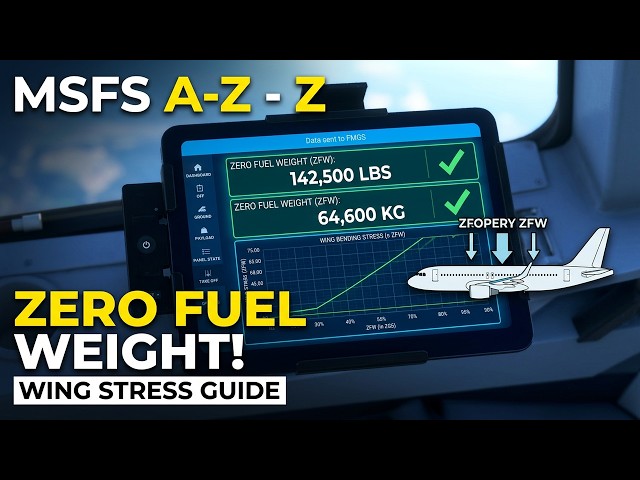
Z is for ZERO FUEL WEIGHT: The critical calculation that saves your wings | MSFS A-Z

S is for STALL: The 4 Steps to Survival | MSFS A-Z

STOP Guessing! Finally Master the A320 MCDU (D.I.F.S.R.I.P.)

G is for Go-Around ✈️ Master the missed approach in MSFS 2024

Dial in your Moza AB6 for the L-39 Albatros | MSFS Jet Class FFB Guide

Master STOL Drag: Moza AB6 FFB setup & controls for the CubCrafters XCub | MSFS